PSA Death Certificate Online Appointment (2026)
Need an official PSA Death Certificate in the Philippines? This guide explains who can request it, the requirements, appointment process, fees, processing time, and common issues all in one easy-to-follow resource. Whether you’re applying for legal, financial, or government purposes, you’ll find everything you need to request the document correctly.
What Is a PSA Death Certificate?
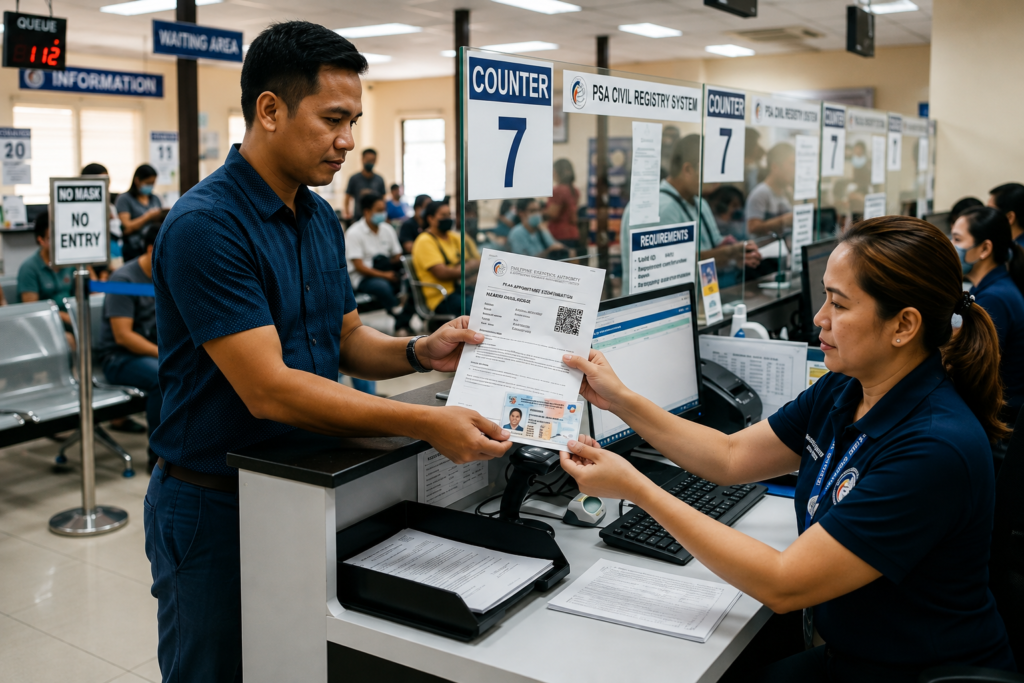
A PSA Death Certificate is an official civil registry document issued by the Philippine Statistics Authority (PSA) that confirms a person’s death has been legally registered. It contains important details such as the deceased person’s full name, date and place of death, cause of death (if recorded), and registration information.
This certificate serves as legal proof of death and is commonly required for settling estates, claiming insurance benefits, processing pensions, transferring property ownership, closing bank accounts, and completing various government and legal transactions.
The PSA Death Certificate is recognized by government agencies, courts, financial institutions, and private organizations throughout the Philippines. For this reason, many institutions require a PSA-issued copy rather than a local civil registry document.
Who Can Request a PSA Death Certificate?
A PSA Death Certificate may be requested by eligible individuals who need the document for legal, personal, or official purposes. In most cases, the following persons can obtain a certified copy:
- Immediate family members of the deceased
- The surviving spouse
- Parents or legal guardians
- Children or legal heirs
- Brothers and sisters
- An authorized representative with a valid authorization letter and supporting identification
- Government agencies or courts when required by law
Before submitting your request, make sure you have the necessary identification and any supporting documents required for your chosen request method. Providing complete and accurate information helps avoid delays during processing.
Common Uses of a PSA Death Certificate
A PSA Death Certificate is required for many legal, financial, and administrative transactions after a person’s death. Government agencies, banks, insurance companies, and courts often ask for a PSA-certified copy to verify the death record.
- Claiming life insurance benefits
- Processing pension and SSS/GSIS benefits
- Estate settlement and inheritance claims
- Transferring land or property ownership
- Closing bank accounts and financial records
- Updating government records
- Family legal proceedings
- Funeral and burial documentation (when required)
Tip: Always keep multiple PSA-certified copies if the certificate will be used for different government or legal transactions.
PSA Death Certificate Requirements
Before requesting a PSA Death Certificate, prepare the necessary information and documents to avoid delays during the application process.
Information You’ll Need
- Full name of the deceased
- Date of death
- Place of death
- Date of birth (if available)
- Parents’ names (if known)
- Purpose of the request
- Your relationship to the deceased
Required Documents
- Valid government-issued ID
- Authorization Letter (if requesting for another person)
- Additional supporting documents (if requested by PSA)
Important: Providing complete and accurate information helps PSA locate the correct record more quickly.
How to Get a PSA Death Certificate Online
Getting a PSA Death Certificate online is one of the easiest ways to request an official copy without visiting multiple offices. Follow these steps:
Visit the Official PSA Appointment Portal
Go to the official PSA appointment website.
Select Your Preferred PSA CRS Outlet
Choose the most convenient PSA office and available appointment date.
Enter the Required Information
Provide the deceased person’s details and the requestor’s information carefully.
Confirm Your Appointment
Review all information before submitting your appointment.
Save Your Appointment Details
Download or print the appointment confirmation for your visit.
Visit the PSA Office
Arrive on time with your valid ID and supporting documents.
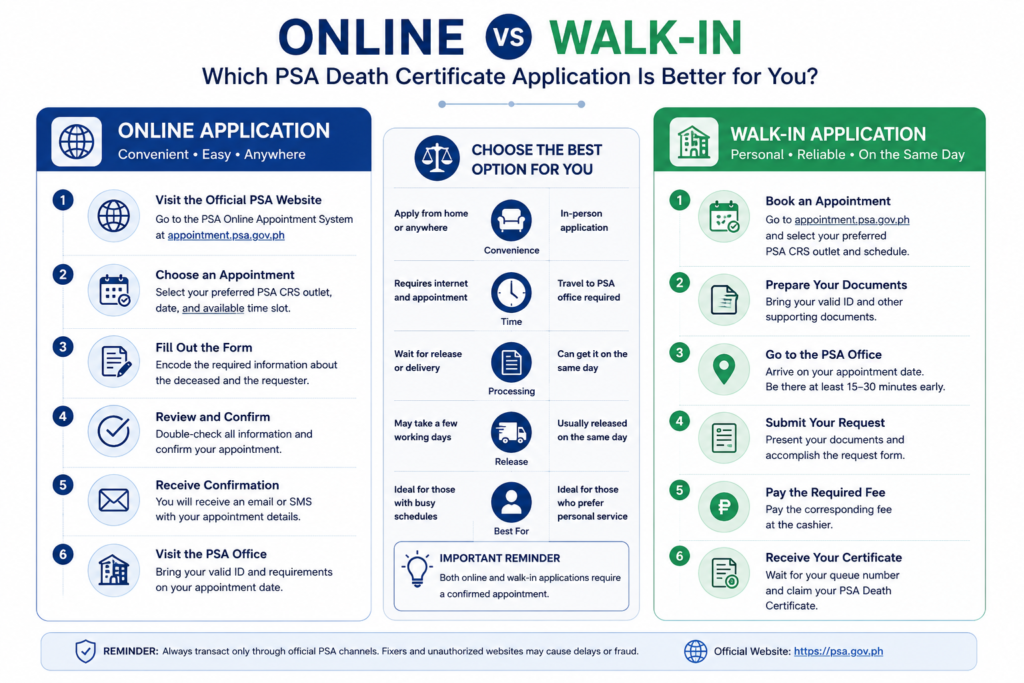
How to Get a PSA Death Certificate Through a Walk-In Appointment
If you prefer an in-person application, you can visit a PSA Civil Registry Service (CRS) outlet. Since most outlets require an appointment, make sure you schedule one before visiting.
Step 1
Book an appointment through the official PSA portal.
Step 2
Prepare your valid ID and supporting documents.
Step 3
Visit the selected PSA CRS outlet on your appointment date.
Step 4
Submit your application and pay the required fee.
Step 5
Wait for your queue number to be called.
Step 6
Receive your PSA Death Certificate or follow the release instructions provided by the office.
Reminder: Arrive at least 15–30 minutes early and double-check all information before submitting your request to avoid unnecessary delays.
PSA Death Certificate Fees & Processing Time
The cost and release time of a PSA Death Certificate depend on how you submit your request. Whether you apply online or visit a PSA Civil Registry Service (CRS) outlet, understanding the applicable fees and expected processing time can help you plan your request more efficiently.
Updated PSA Death Certificate Fees
| Request Method | Estimated Fee |
|---|---|
| PSA CRS Outlet | According to the latest PSA schedule |
| Online Request | Includes document processing and delivery charges |
Note: Fees may change without prior notice. Always check the official PSA website for the latest rates before submitting your request.
Estimated Processing Time
| Request Method | Typical Release Time |
|---|---|
| PSA CRS Outlet | Usually released on the scheduled date, depending on record availability |
| Online Request | Delivery time varies based on your location and courier service |
Tip: If you need the certificate urgently, requesting it through a PSA CRS outlet may be faster than waiting for home delivery.
What Is a CENODEATH Certificate?
A CENODEATH (Certificate of No Death Record) is an official certification issued by the Philippine Statistics Authority (PSA) stating that no registered death record exists for a specific individual in the PSA database.
Unlike a PSA Death Certificate, which confirms that a person’s death has been officially registered, a CENODEATH verifies that no such record can be found.
When Is a CENODEATH Needed?
A CENODEATH may be required for:
- Court or legal proceedings
- Insurance or financial claims
- Government verification
- Correcting civil registry records
- Other transactions requiring proof that no PSA death record exists
CENODEATH vs. PSA Death Certificate
| CENODEATH | PSA Death Certificate |
|---|---|
| Confirms no registered death record | Confirms an officially registered death |
| Used when no record exists | Used as legal proof of death |
| Issued after database verification | Issued from an existing PSA death record |
What If No PSA Death Certificate Record Is Found?
If the PSA cannot locate a death record, it does not always mean the death was never registered. The record may contain incorrect details, may still be undergoing processing, or may not yet have been transmitted by the Local Civil Registry Office (LCRO).
What You Should Do
Verify the Information
Double-check the spelling of the deceased person’s name, date of death, place of death, and other details before submitting another request.
Contact the Local Civil Registry Office
If the record cannot be found, contact the LCRO where the death was originally registered to confirm that it has been properly endorsed to the PSA.
Wait for Record Endorsement
Recently registered deaths may take time before becoming available in the PSA database.
Request Further Assistance
If the problem continues, visit the nearest PSA Civil Registry Service outlet for guidance on the next steps.
Important: Keep any supporting documents, receipts, or local registry records, as they may help the PSA verify or trace the missing record.
Common Mistakes to Avoid
Avoiding these common mistakes can help prevent delays or rejected requests.
- Entering the deceased person’s name incorrectly
- Providing an incorrect date or place of death
- Bringing an expired or invalid government-issued ID
- Forgetting the authorization letter when applying on behalf of someone else
- Booking an appointment using unofficial or third-party websites
- Arriving late for your scheduled PSA appointment
- Submitting incomplete or inaccurate application details
Helpful Tip: Before confirming your request, review every detail carefully. Even a small spelling error can make it difficult for the PSA to locate the correct death record and may delay processing.
Special Cases
Some situations require additional verification or supporting documents before a PSA Death Certificate can be issued. If your request falls into one of the cases below, it’s best to prepare the necessary records in advance.
Death Record Not Yet Available
If the death was recently registered, the record may not yet appear in the PSA database. Wait for the Local Civil Registry Office (LCRO) to endorse the record before requesting a PSA-certified copy.
Request Through an Authorized Representative
If you cannot apply personally, an authorized representative may request the certificate on your behalf. They should bring:
- A signed authorization letter
- Their valid government-issued ID
- A copy of the requestor’s valid ID
- Any additional documents required by the PSA
Incorrect Information on the Certificate
If you notice errors such as an incorrect name, date, or place of death, contact the Local Civil Registry Office where the death was registered. Corrections usually require supporting documents before the PSA can issue an updated record.
Death Registered Overseas
If the death occurred outside the Philippines, additional verification or documents may be required before the record becomes available through the PSA. Processing times may also be longer depending on the case.
Helpful Tip: If your request involves a special case, contact the nearest PSA Civil Registry Service (CRS) outlet before your appointment to confirm the required documents and avoid unnecessary delays.
Frequently Asked Questions (FAQs)
1. Who can request a PSA Death Certificate?
Immediate family members, legal heirs, authorized representatives, and other eligible requestors may obtain a PSA Death Certificate, provided they meet the PSA’s requirements.
2. Is an online appointment required?
Yes. Most PSA Civil Registry Service (CRS) outlets require a confirmed online appointment before accepting requests.
3. What documents should I bring?
Bring a valid government-issued ID and any supporting documents required for your request. If you are applying for someone else, you may also need an authorization letter.
4. How much does a PSA Death Certificate cost?
The fee depends on the request method. Online requests may include delivery charges, while requests at a PSA CRS outlet follow the latest PSA fee schedule.
5. How long does it take to receive the certificate?
Processing time varies depending on the request method, office workload, and record availability.
6. Can someone else request the certificate for me?
Yes. An authorized representative may request the certificate if they present the required authorization letter and valid identification.
7. What should I do if no death record is found?
Verify all information first, then contact the Local Civil Registry Office where the death was registered. If needed, seek assistance from the nearest PSA CRS outlet.
8. What is a CENODEATH Certificate?
A CENODEATH is an official PSA certification confirming that no registered death record exists for a particular individual in the PSA database.
9. Can I use a local civil registry copy instead of a PSA Death Certificate?
Some organizations may accept a local civil registry copy, but many government agencies, banks, courts, and insurance companies specifically require a PSA-issued Death Certificate.
10. How can I avoid delays during my application?
Double-check all information, bring the required documents, arrive on time for your appointment, and use only official PSA channels when submitting your request.
Conclusion
Obtaining a PSA Death Certificate is an important step when handling legal, financial, insurance, or government transactions after a person’s passing. By understanding the eligibility requirements, preparing the correct documents, and following the official appointment process, you can make your request more efficiently and avoid unnecessary delays.
Always use the official Philippine Statistics Authority (PSA) channels for appointments and document requests. Providing accurate information and complete supporting documents will help ensure a smoother application and faster processing.